 Operations & transformation
Most YouTube growth advice focuses on individual tactics.
Post consistently.
Improve thumbnails.
Use better titles.
Create Shorts.
Study retention.
Follow trends.
All of these can matter.
But sustainable YouTube growth rarely comes from optimizing one tactic in isolation.
A channel is a system.
Research influences topics. Topics influence production. Production affects packaging. Packaging determines who clicks. The video experience determines whether people continue watching. Distribution determines who sees the content. Analytics reveal what happened. And those signals should change what the channel does next.
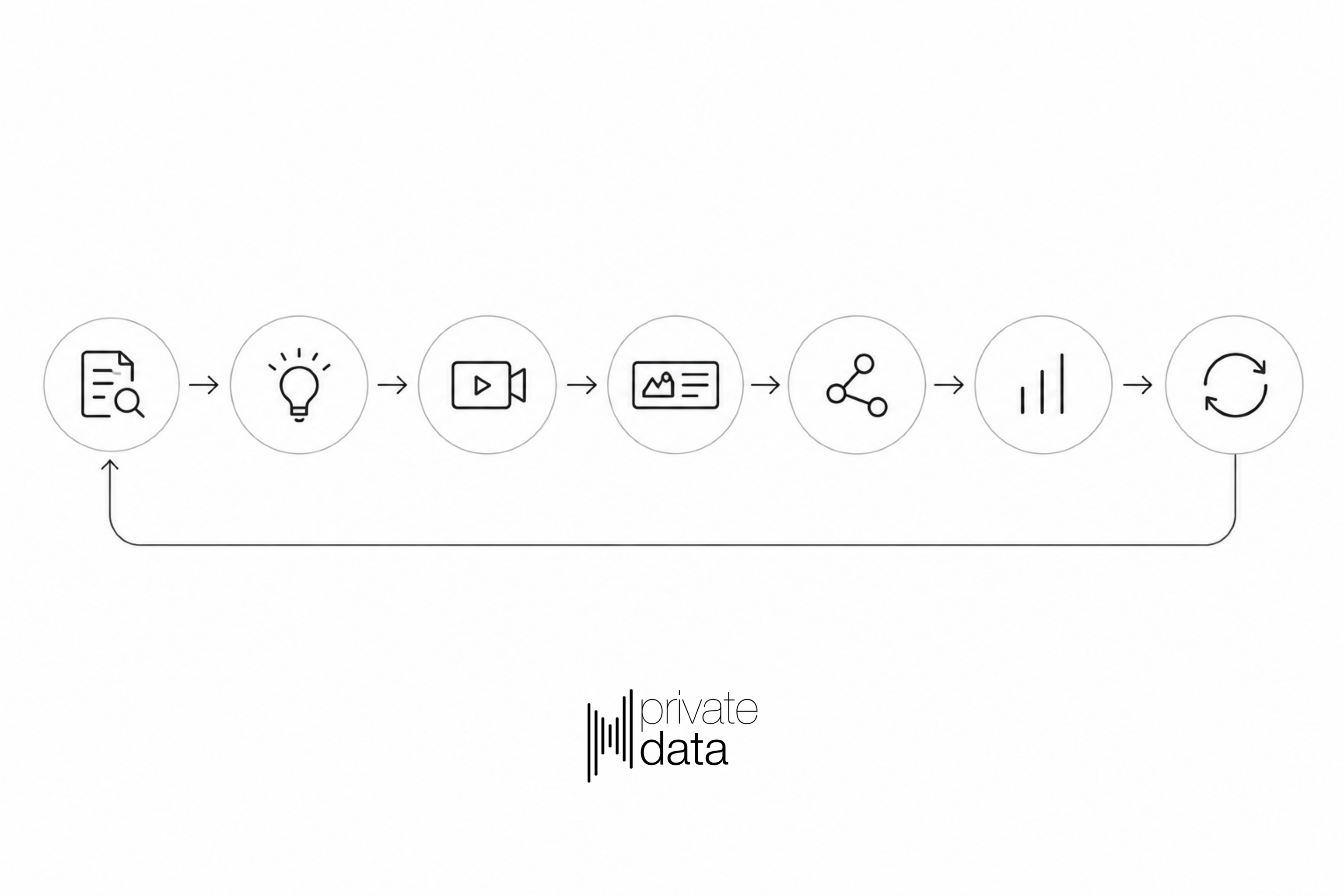
A useful YouTube growth strategy for businesses therefore looks less like a list of content ideas and more like a feedback loop:
Research → Hypothesis → Production → Packaging → Distribution → Performance Signals → Learning → Next Hypothesis
When that loop works, a channel gets smarter over time.
When it does not, teams can publish large amounts of content without understanding why some videos succeed and others disappear.
A YouTube Growth Strategy for Businesses Starts With a System
Businesses often treat YouTube as a publishing channel.
A video gets produced, uploaded, shared, and then the team moves on to the next one.
That creates content.
It does not necessarily create learning.
A stronger system begins with a hypothesis.
For example:
“People responsible for operations in small companies are struggling to understand where AI automation creates useful ROI.”
That hypothesis can become a video.
But the process does not end when the video is published.
The channel should learn:
Did the topic attract the expected audience?
Did the packaging create enough interest to click?
Did viewers stay after the opening?
Which sections held attention?
What questions appeared in comments?
Did viewers continue to another video?
Did the content create business interest outside YouTube?
Those answers should affect the next content decision. Without the feedback loop, the team is producing. With it, the team is building a growth system.

The Seven Layers of a YouTube Growth Operating System
A practical operating model can be divided into seven connected layers.
Research
Good channels do not simply ask:
“What should we publish next?”
They build a repeatable way to discover possible topics.
Useful inputs include audience questions, YouTube search behavior, competitor content, comments, customer conversations, sales objections, existing high-performing videos, broader industry changes, and topics already driving traffic through other channels.
The objective is not to copy whatever is trending.
It is to understand where audience demand overlaps with your expertise and business objectives.
For a business channel, that third component matters.
A video can generate views while attracting people who are unlikely ever to care about the company.
Traffic is useful. Relevant traffic is better.
Content Hypothesis
Every meaningful video should have a reason to exist.
A simple hypothesis might be:
Audience + Problem + Promise
For example:
Small business owners who are overwhelmed by disconnected tools will respond to a practical explanation of how to choose the first workflow to automate.
That is considerably more useful than:
Let's make a video about automation.
A clear hypothesis helps with the script, title, thumbnail, opening, and later analysis.
If the video underperforms, you can ask which part of the hypothesis was wrong.
Production
Production should turn the hypothesis into a repeatable process.
For a small team, that usually means clear stages:
Brief → Script / Structure → Production → Edit → Review → Publish
The objective is not bureaucracy.
It is reducing unnecessary coordination.
A channel becomes difficult to scale when every video is effectively a new project with no stable workflow.
Templates, checklists, naming conventions, content calendars, reusable visual systems, and clear ownership can reduce production friction while preserving creative flexibility.
AI can assist here with research synthesis, first-draft structures, transcript processing, repurposing, chapter suggestions, or repetitive metadata work.
But creative direction and final judgment should remain intentional.
Packaging Is Part of the Product
A strong video that nobody clicks cannot perform.
That makes titles and thumbnails more than promotional assets. They are part of the content product.
The promise created by the packaging should match what the video actually delivers. If the promise is too weak, viewers may never click. If it is exaggerated, they may click and leave quickly.
A useful packaging process asks:
What is the central tension?
What does the viewer expect to learn or experience?
Can the idea be understood in seconds?
Does the title add information rather than simply repeat the thumbnail?
Packaging should be treated as a testable hypothesis. Not as decoration added five minutes before publishing.
Performance Signals Diagnose Different Problems
One of the biggest mistakes in YouTube analytics is treating all weak performance as the same problem.
Different metrics point to different parts of the system.
Suppose a video receives many impressions but few clicks.
The content itself may not be the immediate issue.
The problem may be the topic, title, thumbnail, or audience match.
Now imagine the opposite:
The video gets strong clicks, but viewers leave quickly.
Packaging worked.
The problem is more likely inside the video: the opening, structure, pacing, clarity, or mismatch between promise and delivery.
Another video may have strong retention but receive limited distribution.
That can indicate a narrower topic, insufficient initial audience signals, or packaging that limits broader discovery.
The point is not to chase one universal benchmark. It is to diagnose where the growth system is breaking.
Build a Feedback Loop, Not an Analytics Dashboard
Many channels collect analytics. Far fewer have a process for turning analytics into decisions.
A useful review should end with an action.
For example:
Observation: viewers consistently leave during long introductions.
Decision: future videos begin with the problem and expected outcome before background context.
Or:
Observation: videos about one customer problem consistently attract stronger qualified engagement.
Decision: build a content cluster around that problem.
Or:
Observation: strong videos are generating search traffic months after publication.
Decision: create related evergreen videos and internal links between them.
Analytics are valuable when they change future behavior. Otherwise, they are simply reporting.
Distribution Should Not Begin After Publishing
YouTube itself is only one part of distribution.
A business may already have:
LinkedIn;
email;
a blog;
a website;
customer communities;
partnerships;
sales conversations;
short-form channels.
A strong video can become an asset across that wider system. But repurposing should not simply mean copying the same message everywhere.
One long-form video might produce:
a short explanation for LinkedIn;
a blog section;
several Shorts;
a customer FAQ;
a sales follow-up resource;
an internal knowledge asset.
The important question is:
Where can this content continue creating value after publication?
That changes YouTube from an isolated channel into part of the wider marketing and operational system.
Where Automation Helps YouTube Operations
YouTube contains a surprising amount of repetitive work.
AI and automation can help with tasks such as:
organizing content ideas;
transcript processing;
producing draft descriptions;
extracting Shorts candidates;
creating chapter suggestions;
generating internal performance summaries;
categorizing comments;
moving approved content through production stages;
distributing finished content to other systems;
updating internal content databases.
The objective is not to automate creativity.
It is to remove repetitive operational work around creativity.
A useful rule is:
Automate coordination and processing before automating creative judgment.
A system can prepare options.
A person should still decide what represents the brand.
Content Volume Is Not the Same as Growth
Increasing publishing frequency can help when the system already works.
It can also multiply weak decisions.
If topic selection is poor, more videos create more poor topics. If packaging is weak, more uploads create more ignored thumbnails. If analytics are never translated into decisions, more data creates more dashboards without more learning.
Before increasing volume, identify the bottleneck. Ask:
Is the problem insufficient content?
Or is it:
weak research;
inconsistent production;
poor packaging;
low retention;
disconnected distribution;
unclear audience fit;
no feedback loop?
The correct intervention depends on the answer.
Business Channels Need More Than Views
For creator-led entertainment channels, views may be closely connected to the business model.
For a company, they may not be.
A business channel should understand what role YouTube plays.
It could support:
Discovery Introducing the company to people who did not previously know it.
Trust Demonstrating expertise more deeply than a short social post can.
Education Helping potential customers understand complex problems.
Qualification Allowing viewers to decide whether the company's approach fits their needs.
Conversion support Providing content that helps prospects move toward a decision.
Retention and customer success Teaching existing customers how to get more value.
The correct YouTube strategy depends on which of these functions matters most.
A video with 5,000 highly relevant views may create more business value than one with 100,000 views from an unrelated audience.
That is why business channels need two measurement layers:
Channel performance
and
Business impact
They are related, but they are not the same thing.
A Practical Weekly YouTube Review
A useful review does not need to become a large analytics meeting.
For each important video, ask:
Did people click?If not, investigate topic and packaging.
Did they continue watching?If not, investigate the opening and delivery.
Where did attention change?Look for structural patterns.
Who appears to be watching?Are you reaching the audience you intended?
What did viewers say or ask?Comments often reveal future content opportunities.
Did the video create downstream behavior?Website visits, enquiries, subscriptions, additional video views, or other business signals.
What should we change next?
The last question is the most important. The review should create a new hypothesis.
The YouTube Growth Loop
The complete system can be summarized as:
Research → Hypothesis → Production → Packaging → Distribution → Performance → Learning
Then:
Learning → Better Research → Better Hypothesis
That feedback loop is what creates compounding improvement.
A growing library also changes the economics of the channel.
Each useful video can continue working after publication.
Evergreen content can generate discovery through search.
Related videos can reinforce each other.
Strong content can become part of sales conversations, blog posts, email sequences, and customer education.
Over time, the channel becomes less like a feed and more like an information asset.
Build a Channel That Learns
A sustainable YouTube strategy is not simply:
publish more videos.
It is:
build a system where every video improves the next one.
That requires good research, clear hypotheses, disciplined production, deliberate packaging, thoughtful distribution, meaningful analytics, and a feedback loop connecting all of them.
Automation can reduce the operational burden.
AI can accelerate research, analysis, and processing. But growth still depends on understanding the audience and making good decisions.
The strongest channels do not merely produce content consistently. They learn consistently.