
AI Marketing Automation for Small Businesses: Building the System Behind the Campaigns
Updated: Oct 5
AI is making it easier than ever to generate content, personalize messages, analyze audiences, and automate marketing tasks. However, easier automation does not necessarily create better marketing.
A business can automate lead generation, email sequences, content production, and campaign reporting while still losing opportunities between marketing and sales. It can generate more leads while having no reliable way to determine which ones matter. It can produce more data while learning very little from what eventually becomes a customer.
The problem is often not the AI itself. It is the operational system surrounding it.
Effective AI marketing automation requires more than just connecting a few tools. It requires a structure that connects customer signals, CRM data, qualification, human decisions, commercial outcomes, and feedback. The goal is not simply to automate marketing; it is to build a system that can learn from what happens after marketing.

AI Marketing Automation for Small Businesses Is Part of a Larger Operational System
Marketing rarely operates independently. A potential customer may discover a business through search, LinkedIn, advertising, a referral, or a piece of content. That interaction creates a signal. The signal may become a lead, the lead may enter a CRM, and eventually, someone must decide whether there is a genuine commercial opportunity.
A simplified system might look like this:
Signal → Capture → CRM → Qualification → Action → Human Handoff → Outcome → Feedback
Each stage depends on the previous one. If information is lost between stages, automation simply moves incomplete information faster.
For example, automatically adding every new contact to a CRM solves the data-entry problem. However, it does not answer more important questions:
Is this account actually a good fit?
Is there evidence of a problem we can solve?
What has this person already interacted with?
Should the system continue automatically or involve a person?
Did the lead eventually become an opportunity?
Why was the opportunity won or lost?
These are operational questions rather than purely marketing questions. They determine whether marketing automation creates business value.
The Difference Between Activity and Commercial Progress
One of the easiest mistakes in marketing automation is optimizing for activity. AI can dramatically increase the amount of activity a small team can produce: more prospects researched, more messages personalized, more content generated, more campaigns tested, more leads processed. But volume is not the same as progress.
Consider an automated outbound system that discovers companies, identifies contacts, generates personalized messages, and records responses in a CRM. Technically, the system may work perfectly. Commercially, it may still perform poorly if every company matching basic demographic criteria is treated as an opportunity.
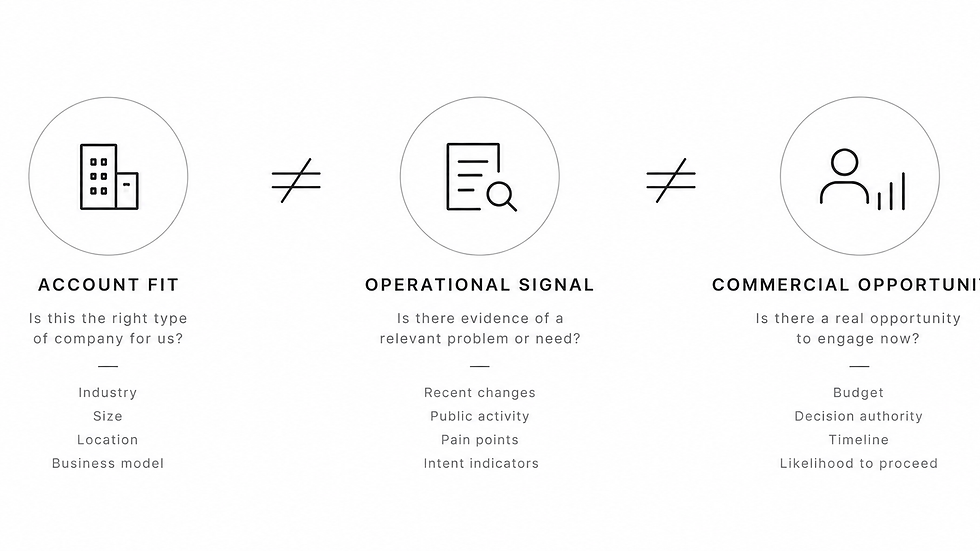
A stronger architecture separates different questions.
Account fit asks whether the company resembles the type of organization the business can realistically serve.
Operational signal asks whether there is evidence of a relevant problem, transition, inefficiency, or need.
Commercial opportunity asks whether that combination has developed into something worth active human attention.
This distinction matters because AI is particularly good at processing large quantities of information. Without clear decision rules, however, it can also scale weak assumptions. Good automation should therefore reduce unnecessary work before it increases activity.
Start With the Information Flow, Not the AI Tool
Before choosing an AI platform or building an automation, map how information currently moves through the marketing and commercial process. For each important signal, identify:
Where does it originate?
A website form, email, social interaction, advertising platform, referral, event, sales conversation, or another source.
Where is it stored?
The CRM should usually become the durable commercial record rather than leaving important context scattered across marketing platforms.
What decisions depend on it?
For example: qualification, segmentation, follow-up priority, campaign selection, or escalation to a person.
Who owns the next action?
Automation becomes unreliable when responsibility is ambiguous.
What should happen afterwards?
Every important workflow needs an outcome rather than simply an automated action.
This mapping often reveals that the most valuable improvement is not adding AI at all. The business may first need cleaner CRM fields, better ownership rules, a consistent qualification process, or reliable connections between existing tools. Once that foundation exists, AI becomes considerably more useful.
Where AI Actually Adds Value
AI marketing automation for small businesses works best when introduced at points where interpretation is useful but full human attention is unnecessarily expensive.
Research and signal detection
AI can review public information, CRM history, form responses, conversation notes, or other permitted sources and surface relevant patterns. Instead of simply asking whether a company belongs to a particular industry, a system can help identify signals suggesting that deeper research may be worthwhile.
Classification and qualification support
AI can summarize information and classify it against defined criteria. The important distinction is that the criteria should come from the business logic. AI should not quietly invent what constitutes a valuable lead.
Personalization
AI can help adapt messaging to available context without requiring someone to write every message manually. But personalization should follow qualification, not substitute for it. A highly personalized message sent to the wrong prospect is still the wrong message.
Conversation processing
Emails, meeting notes, call transcripts, and objections contain valuable commercial information. AI can help turn this unstructured information into structured CRM updates, questions, objections, requirements, or next actions.
Pattern discovery
Once enough outcomes exist, AI can help identify patterns across successful and unsuccessful opportunities. This is where the system becomes more interesting: information generated at the end of the funnel begins improving decisions made at the beginning.
Human-in-the-Loop Is an Architectural Decision
Human oversight should not be added as an emergency safeguard after an automation has been built. It should be designed into the workflow. Some actions are low-risk and highly repeatable. Others involve context, reputation, customer relationships, compliance, or commercial judgment. The system should distinguish between them.
For example, AI might safely:
summarize a conversation;
enrich an internal CRM record;
categorize an objection;
suggest a next action;
prepare a draft response.
A person may still need to approve:
sensitive outbound communication;
qualification of an ambiguous opportunity;
unusual commercial terms;
important changes to customer status;
actions with legal, privacy, or reputational consequences.
This creates a useful principle:
Automate processing aggressively. Automate judgment selectively.
Human involvement then becomes concentrated around decisions where it creates the most value instead of being required for every administrative step.
The CRM Should Connect Marketing to Reality
A CRM becomes much more valuable when it records more than contact information and pipeline stages. It can provide the connection between marketing activity and actual commercial outcomes. Imagine a business runs several campaigns around different customer problems. Without a connected system, marketing may know which campaign produced clicks and leads. Sales may know which conversations seemed promising. The owner may know which deals eventually closed. But those three perspectives may never reconnect.
A better system can preserve the chain:
Campaign → Signal → Lead → Qualification → Conversation → Opportunity → Outcome
Now the business can ask better questions:
Which signals tend to produce real opportunities?
Which campaigns generate activity but weak commercial intent?
Which objections repeatedly appear during conversations?
Which customer problems correlate with successful engagements?
Which qualification assumptions turned out to be wrong?
Marketing can then learn from revenue rather than merely engagement.
Build the Feedback Loop
The final component is frequently missing from automation projects. The workflow should feed its outcomes back into itself. Suppose an AI-assisted system identifies and qualifies prospects. Humans review the strongest candidates. Conversations take place. Some become opportunities; others do not. The reasons matter.
A rejected prospect might reveal that the original ICP was too broad. Repeated objections might reveal that the messaging is unclear. Successful customers might share an operational characteristic that was not originally included in the scoring model. A new buying pattern might suggest a different campaign.
Those observations should return to the system:
Outcome → Learning → Updated Criteria → Better Decisions
This turns automation from a collection of workflows into an evolving operating system. Not every part of that loop needs AI. Deterministic rules are often preferable when the logic is clear and predictable. AI becomes valuable where interpretation, synthesis, or pattern recognition is required.
A Practical Implementation Sequence
For a small business, there is little reason to build the entire architecture at once. Start with one meaningful workflow. First, map the current process from signal to outcome. Identify where information is lost, duplicated, manually transferred, or left without ownership. Then establish the minimum reliable data structure in the CRM. Define qualification criteria and identify which decisions can be deterministic, which benefit from AI assistance, and which require human judgment. Only then automate repetitive transitions.
Once the workflow is running, capture outcomes and reasons rather than simply counting completed actions. Finally, use those outcomes to refine the original rules. This sequence is less exciting than immediately deploying multiple AI agents. It is also considerably more likely to produce a system that survives contact with real business operations.
From Marketing Automation to an Operating System
The most useful question is therefore not:
“What marketing tasks can we automate with AI?”
A better question is:
“How should information and decisions move from the first customer signal to a commercial outcome — and where can AI improve that system?”
That change in perspective matters. AI marketing automation can generate content, research prospects, classify information, personalize communication, and reduce repetitive work. But its real value appears when those capabilities become part of a coherent operational system.
The result is not simply faster marketing. It is a business that can capture signals, make better decisions, preserve context, involve people at the right moments, and learn from its own outcomes. That is a much stronger foundation for automation — and for growth.


Comments